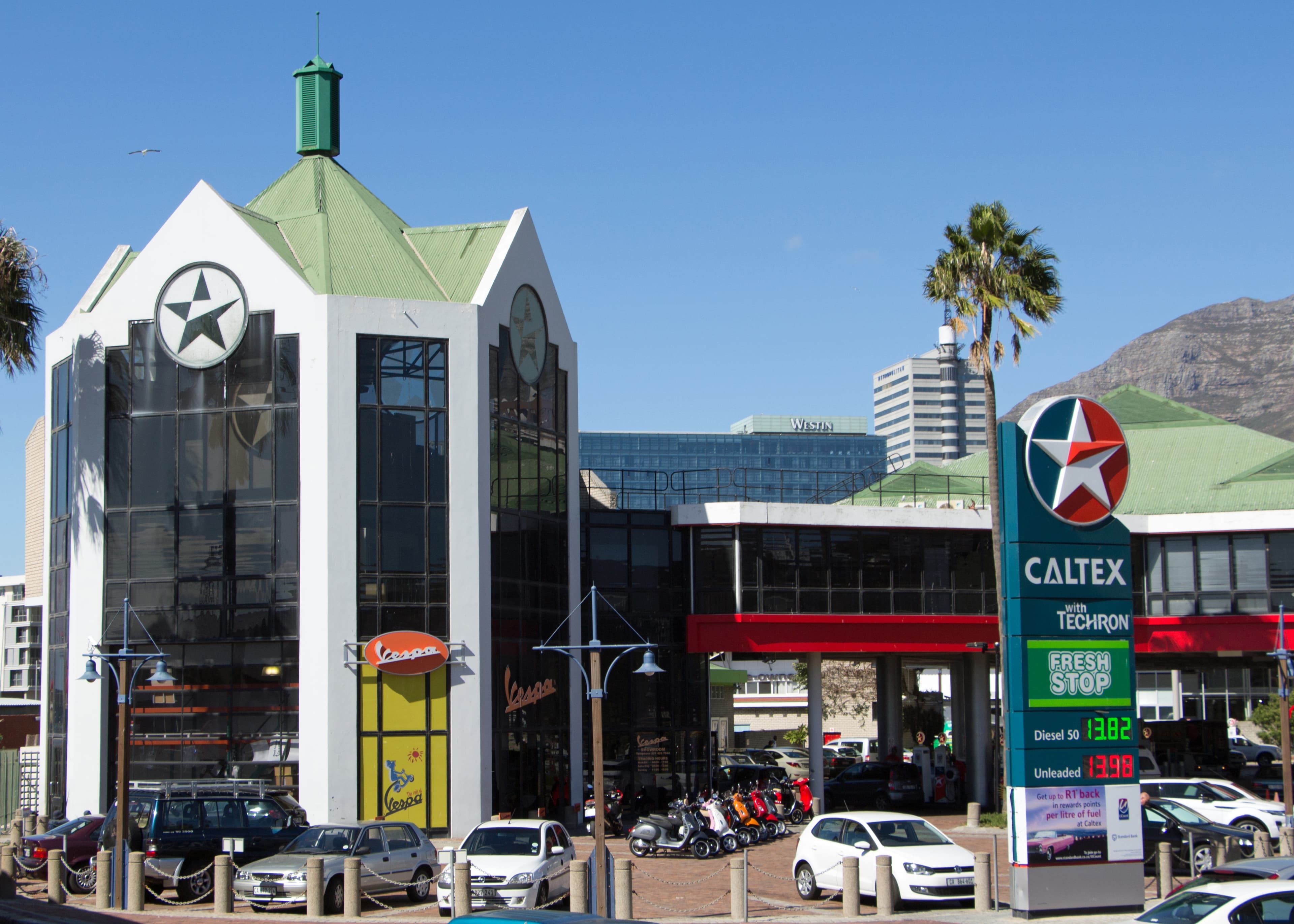
File photograph: a Caltex petrol station at Cape Town’s V&A Waterfront on April 23, 2014. The displayed pump prices are historical. · HelenOnline · CC BY-SA 3.0 · Resized for display.
Rising payment values and transaction volumes failed to prevent a monthly fall in PayInc’s -adjusted activity indicator as fuel pressures returned.
The monthly decline and the yearly gain
South Africa’s payments-based economic activity indicator fell in September as renewed fuel-price pressures weighed on businesses and households. The PayInc economic index declined 0.4% month on month following a 1.2% increase in August, Business Day reported on October 14.
The index stood at 103.8, which was still 1.8% higher than in September a year earlier. The monthly fall and annual gain describe different comparisons: activity weakened from August while remaining above the level recorded a year before.
PayInc combines the value of electronic transactions cleared through its system with wholesale cash demand. The measure uses real prices, removing recurring seasonal patterns and the effect of price changes. It is an indicator of activity and should not be read as a direct growth estimate.
Transaction numbers rose to 197.3 million from 196.3 million in August, although they remained below July’s record 201.5 million. Volumes were 9% above a year earlier. transaction value rose to R1.447 trillion from R1.426 trillion; most payment streams showed modest increases in value and volume, while cash supplied to banks rose slightly.
Those payment totals help explain the mixed picture. More transactions and higher rand values can coexist with a fall in a measure adjusted for prices and seasonal patterns. The index and the unadjusted payment totals answer different questions about the economy.
Fuel relief gives way to renewed pressure
PayInc said lower fuel prices in July and part of August had temporarily supported activity. Renewed tensions between the United States and Iran pushed domestic prices higher in September and to record levels in October. Russia’s continuing attacks on Ukrainian energy infrastructure added to fuel-supply concerns.
Independent economist said the inverse relationship between fuel prices and the index had been particularly visible since March. Her warning was forward-looking: record October prices left the risk of a further slowdown elevated.
PayInc said households and businesses would watch the following week’s medium-term budget policy statement for signs that finance minister could offer more fuel-levy relief. Labour federation Cosatu was among those calling for a return of the temporary April reprieve, which involved an estimated R17.2 billion in forgone tax receipts. Further relief remained a question about fiscal room, rather than an announced measure.
Surveys diverge as monetary policy tightens
The S&P Global private-sector fell to 49 in September from 50.5 in August, indicating deteriorating conditions. Absa’s manufacturing moved the other way, rising 4.9 points to 50.7 after three months of contraction. New sales orders recovered strongly and factory activity regained much of the ground lost in August.
PMIs are business surveys that summarise improving or deteriorating conditions. The manufacturing recovery therefore did not erase weakness in the broader private-sector survey.
The Reserve Bank unanimously raised its by 25 to 7.25% as it sought to contain expectations. Governor acknowledged the economy’s distress following a 0.2% contraction in the second quarter. The bank’s recent policy review warned that failing to contain the oil shock’s pressures could hurt consumers and businesses.
PayInc’s full-year assessment remained subdued. Higher fuel prices, geopolitical uncertainty and weaker business confidence continued to threaten investment and economic activity, despite the better manufacturing survey.